Shops don’t jump from entry-level 3-axis straight into full simultaneous 5-axis overnight. There’s a wide range of work that sits in the middle: parts with multiple faces, tighter tolerances, and the need for more uptime but not necessarily true sculpted geometry.
Horizontal machining centers fit that space well. They’re flexible, scalable, and often work alongside 5-axis machines, not in place of them.
From 3-Axis to 5-Axis: Understanding the CNC Machining Spectrum
A shop’s machine lineup is usually built around these configurations:
3-axis for simple prismatic work, flat surfaces, and straightforward programming.
4-axis CNC machining adds indexed rotation for more faces per setup.
5 axis CNC machining center unlocks continuous multi-surface contouring and true freeform geometry.
Cost, part complexity, programming skill, and batch size all influence the right choice. Many shops mix all three to balance throughput and capability. You can view Methods’ range of machine types here: CNC Machines Overview
Quick Comparison
| Machine Type | Best For | Capabilities | Limitations |
| 3-Axis | Basic prismatic parts, low cost | Simple setups, easy programming | Multiple ops, more fixturing |
| 4-Axis (3+1) | Multi-face parts, medium complexity | Indexed rotation, fewer setups | Not true simultaneous contouring |
| 5-Axis | Aerospace, medical, complex shapes | Full simultaneous machining | Higher cost, more skill required |
What Makes Horizontal Machining Centers Different?
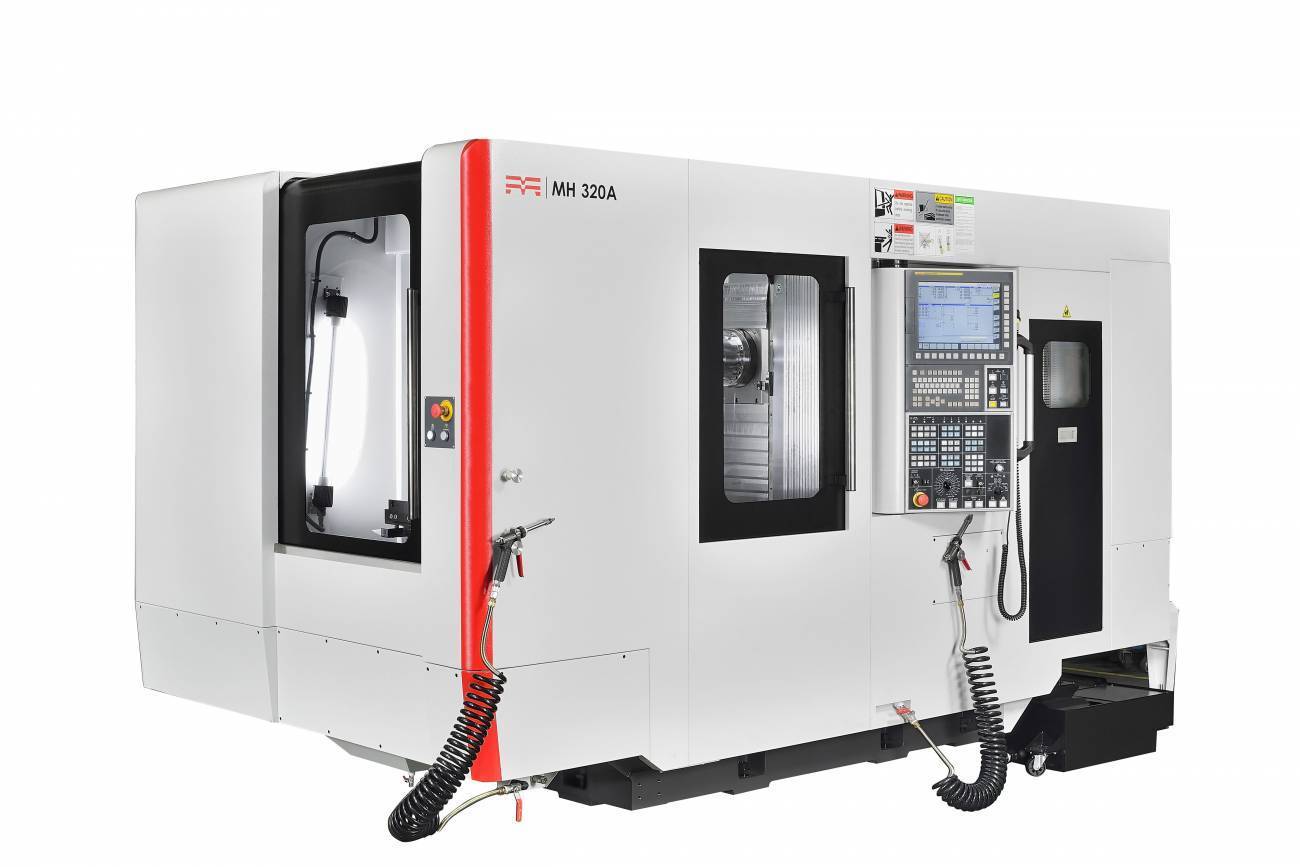
A horizontal CNC machining center is built around a spindle that approaches the part from the side rather than from above. That single difference changes everything about chip flow, uptime, and the number of surfaces you can hit in one cycle.
Most horizontals include a built-in rotary 4th axis, giving shops efficient 3+1 machining with minimal re-fixturing. Add multi-pallet capacity, and horizontals become a steady source of uptime, especially in shops trying to keep machines cutting instead of waiting on setups.
Explore current models:
Horizontal Machining Centers
Multi-Pallet Machining Solutions
Key advantages include:
- Better chip evacuation due to gravity
- More tool access across multiple faces
- Consistent uptime with pallet changers
- Easier automation integration
- Fewer touches, more finished parts per shift
Bridging the Gap: Horizontal Machining in High-Mix Workflows
High mix low volume machining doesn’t reward slow changeovers or machines that sit idle between jobs. Horizontals help fill that gap by keeping the spindle running while the next job is being prepped offline.
With a horizontal:
- Better chip evacuation due to gravity
- More tool access across multiple faces
- Consistent uptime with pallet changers
- Easier automation integration
- Fewer touches, more finished parts per shift
Explore how Methods supports job shops here: Job Shop Industry Solutions
When 5-Axis is Essential, and When It’s Not
A 5 axis CNC machining center is unmatched for sculpted surfaces, deep undercuts, impellers, medical forms, and other geometry-driven parts. When a project requires simultaneous motion, horizontals can’t replace that capability.
But many shops find that a surprising amount of work, medium-complexity, multi-face parts, runs more efficiently on an HMC. That frees up their 5-axis machines for jobs that truly require them. See current 5-axis platforms: 5-Axis Machining Centers
Use 5-axis for:
- Complex aerospace or medical surfaces
- Multi-curve geometries
- Parts needing simultaneous motion
Use horizontals for:
- Multi-face parts
- Medium-complexity work
- Jobs that benefit from uptime and palletization
The smartest shops use both to balance schedules and avoid overloading their 5-axis machines with work that doesn’t need them.
Real-World Use Cases: Horizontals in Action
Horizontals work especially well when shops are juggling varied part types or need predictable throughput without adding staff or extended hours.
Common scenarios:
- Running multiple part numbers across two or three pallets
- Keeping machines cutting through shift changes
- Reducing setup time compared to verticals
- Pairing an HMC with automation for true lights-out work
Related Methods solutions:
Vertical Machining Centers
Automation Systems
Building a Flexible Machine Strategy
A well-rounded shop usually grows in stages. Start with dependable 3-axis machines. Add horizontals as the work mix increases or setups start clogging the schedule. Layer in 5-axis once geometry, not just throughput, demands it.
Good strategies often include:
- Using horizontals to decongest overloaded verticals
- Reserving 5-axis for simultaneous-motion jobs
- Balancing uptime with palletized workflow
- Taking advantage of ready-to-ship models to scale quickly
Browse available inventory here: Ready-to-Ship Machines
Final Take: Flexibility Over Force-Fitting
Horizontal machining centers don’t compete with 5-axis systems. They fill the space in between. They give shops a way to scale, stay flexible, and increase output without forcing every job into a 5-axis workflow. And when 5-axis is truly needed, it’s an essential part of a modern machining lineup. Methods provides both paths, so shops can build the machine strategy that fits their work, not the other way around. Contact us to learn more.
Related FAQs
What’s the difference between horizontal and 5-axis machining centers?
A horizontal CNC machining center uses a side-mounted spindle and often a rotary 4th axis to access multiple faces in indexed steps. A 5-axis machine adds simultaneous motion across five axes, which is essential for true contouring and complex 3D surfaces. Horizontals boost uptime and throughput, while 5-axis machines expand geometric capability.
Can horizontal machines handle complex parts?
Yes, within reason. Horizontals excel at medium-complexity parts with multiple faces, bores, or critical datums. They’re not designed for fully sculpted surfaces or deep compound curves, which is where 5-axis machines take over.
Do I need 5-axis for multi-face parts?
Not always. If you’re machining prismatic components that simply need rotation to access different faces, a horizontal with a 4th axis is usually faster, easier to program, and more efficient. You only need 5-axis when the geometry requires simultaneous movement.
What are the benefits of 4-axis vs 5-axis CNC machines?
4-axis CNC machining gives you indexed rotation, fewer setups, and better fixture access without the programming complexity of full 5-axis. A 5-axis CNC machining center gives you continuous motion for contoured or organic shapes. Many shops run both, 4-axis for throughput, 5-axis for geometry.
How do multi-pallet systems improve uptime?
Multi-pallet systems keep the spindle cutting while the next job is being prepped offline. Operators load fixturing and parts at a separate station, then swap pallets instantly. This reduces idle time, smooths out high-mix workflows, and makes lights-out machining achievable.
Is a horizontal machine more expensive than a vertical?
Typically, yes. HMCs cost more upfront due to pallet systems, rotary axes, and their production-focused design. But for many shops, the additional uptime and reduced setup time mean the machine pays for itself faster than a vertical running the same workload.
Selecting the Right Horizontal Machining Center
Case Study
Understanding When, Why and How to switch to from vertical to horizontal Cnc machining
Horizontal Machining Centers
Featured
Machines
